
Here is what I did and how I felt during my first month after arriving.
These are the main things I did after I arrived.
• The trip: Japan to the U.S. (Seattle) to Canada
• Life in a homestay
• Battling a 39°C fever and cough-variant asthma
• Daily essentials and paperwork
The trip: Japan to the U.S. (Seattle) to Canada
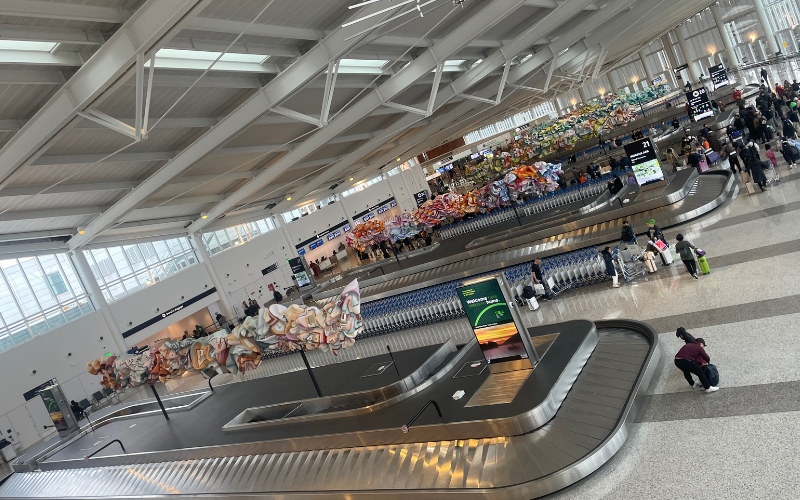
To keep costs down, I booked a flight via Seattle.
I had worried about the transfer, but I had traveled abroad several times before, so it went surprisingly smoothly. I only saw the airport in Seattle, but the burly security guards and the style of service felt so very “America” (laughs). I want to take a proper trip there before I go back to Japan!
The flight from Seattle to Canada was over in no time. After arriving in Canada, I went through immigration and my visa procedures, then headed from the airport to my host family’s home.
In my case, my agent had put together the points to watch out for in advance, so immigration and the visa procedures went smoothly, but without that support I would have been a little worried. I will write about it in detail someday, but especially for your visa, if you do not check what you need and prepare thoroughly beforehand, I imagine mistakes could be impossible to undo.
Life in a homestay

I call it a homestay, but what I actually asked my agent for was a room share.
That is because I am not great with fixed rules and meals, and cooking actually refreshes me, so I wanted to make my own food. That is why I asked for a room share.
But when I got the details of the house, it looked like a family lived there too, and I thought, “Wait, am I living with someone’s family…?” When I actually visited, it was a very large house. It turned out to be a room share where you rent a room in a family’s home. I cook my own meals and share common spaces like the fridge and bathroom with the family.
At first I was quite anxious about living with a family I did not know, but arriving exhausted and full of worries, being welcomed so warmly by my host family made a difference to my mental health that nothing could replace. I did not realize it before I came, but having a family right there with me had a huge impact.
Of course, I have heard about all kinds of problems from friends who chose host families, such as rules that were too strict, food that did not suit them or arguments, so I cannot generalize. But now that I live in a room share, I recommend living with local people at least once.
Right after arriving: battling a 39°C fever and cough-variant asthma

After arriving, the first wall I hit was jet lag and getting sick.
I am 99% sure it was COVID. It was so rough that all I could do was laugh it off… (laughs)
I heard later that many people get sick from jet lag. No matter how hard I tried to fix my jet lag by walking and getting sunlight during the day, my stomach would rumble and act up in the middle of the night, and I could not sleep at all.
Of course I got sleepy during the day, but I held out, telling myself that if I napped I would not sleep at night. My lack of sleep kept building, my immune system weakened, and a vicious cycle began. One week after I arrived, I finally came down with a 39°C fever.
Barely able to stand, I researched clinics and local medicine, but there were so many kinds of medicine here that I had no idea which was right (I did not even know whether I had COVID or the flu).
I had brought medicine from Japan for exactly this kind of situation, but to my surprise, it did not work at all. (Was it because it was COVID, or does a local cold only respond to local medicine…?) In the end, I bought about three types of local medicine and recovered with time.
But because I felt so sick in my very first month, I can now laugh off hard times with the attitude that nothing could be worse than that (laughs).
In short, if you are not flying direct, I think using medicine to help you sleep is a smart option. If I might get jet lag again, I will definitely use NEO CITRAN (a common medicine for early cold symptoms; the nighttime version makes you drowsy as a side effect).
When you are overwhelmed, you are more likely to get scammed
After arriving in Canada, I was swamped with some kind of application or procedure every day.
Besides submitting documents to my school, there was opening a bank account, applying for a SIN (Social Insurance Number), buying a Compass Card, getting ID and exchanging the minimum amount of money… Feeling unwell the whole time, I think I was just desperate to get by. Honestly, I was in a daze and chasing something every day, so I barely remember any of it (laughs).
At the same time, there were daily essentials, buying food, figuring out local transit, looking for a place to live, and so on. I did not feel any big culture shock in Canada, but of course I had nothing of my own here, and I realized that this is what it means to start life from zero abroad.
When looking for a place to live, I gathered information in advance and asked friends and my host family for advice, so I was not scammed, but I often hear of people around me who were.
Honestly, I think anyone is overwhelmed after arriving, so I recommend gathering as much information as you can before you leave. Once you know the key points, I honestly do not think the chances of falling for a scam are that high. I would like to write about this in more detail in the future.
That is a summary of my first month after arriving. You will likely spend your days chasing paperwork and other tasks, so I think research and asking friends for advice are essential.

Comments are closed.